Top Poker Sites
  Best Online Sports Betting Sites
  Claim the Best Online Gambling Bonuses
  The Best Slots Games to Play Online
  Reviews of Online Gambling Sites
 World Cup Bracket (2026): 32-Team Knockout Bracket



Affiliate Disclosure: Some links on Gambling Nerd are affiliate links. If you use them to sign up or deposit, we may earn a commission at no extra cost to you. These rewards help fund new guides, but they never influence our verdicts. Our recommendations are based on independent research and our own ranking system.
The 2026 World Cup is the biggest tournament in soccer history. If you're running an office pool or tracking the action with friends, you need a bracket that actually works.
This guide covers everything: downloading your free 2026 World Cup bracket, understanding the expanded format, and making picks that give you a real shot at winning.
Nerd Picks of the Month



-

-

-

-
+4 more



-
-
-

-
+12 more



-
-
-
-
+8 more



-
-
-
-
+12 more






-
-
-
-
+13 more




-
-
-
-
+13 more




-
-
-
-
+16 more


-
-
-
-
+12 more

-
-

-
-
+2 more

-
-
-
-
+15 more


-
-
-
-
+9 more

-
-
-
-
+11 more

-
-
-
-
+4 more
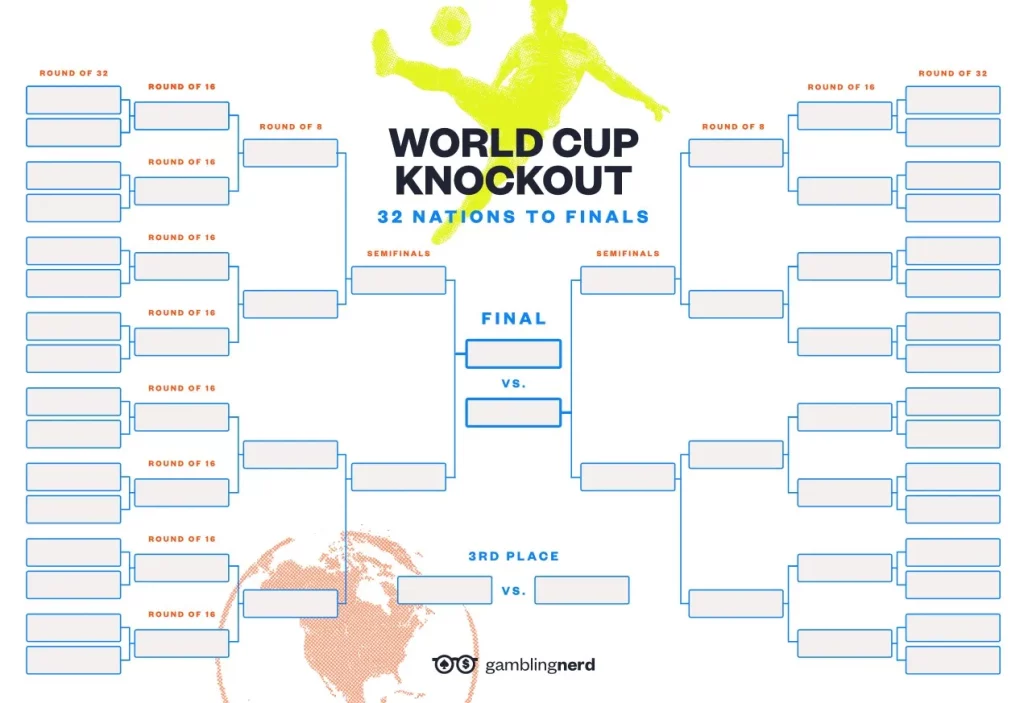
Download Your Free 2026 World Cup Bracket PDF
Grab your printable 2026 World Cup bracket right here. This PDF covers the complete knockout stage (all 32 teams from the Round of 32 through the Final on July 19). It’s formatted for office pools, watch parties, and prediction contests. Print it, fill it with a pen, and pass it around without needing apps or accounts.
The bracket is clean and built for the new 48-team format.
How the 2026 FIFA World Cup Format Works
Here’s what trips up everyone who filled out a bracket in 2022 or earlier: the format has changed. The 2026 FIFA World Cup features 48 teams across 12 groups, up from 32 teams and 8 groups. That’s a massive expansion that completely reshapes the knockout stage.
The group stage produces 32 teams that advance. The top two finishers from each of the 12 groups automatically move on (that’s 24 teams). Then the 8 best third-place finishers also advance, bringing the total to 32. Your downloadable bracket starts with 32 teams and covers only the knockout stage, not the group stage.
The tournament runs June 11 to July 19, 2026, across 16 host cities in the USA, Canada, and Mexico. The group stage wraps up in late June, the Round of 32 kicks off in early July, and the Final happens at MetLife Stadium in New Jersey on July 19. This year’s Round of 32 is the new opening round, and it’s single elimination from the first whistle.
The Group Stage: How 48 Teams Become 32
The group stage is straightforward: 12 groups of 4 teams each. The top two teams from every group advance automatically based on points, goal difference, and goals scored (that’s 24 teams). The remaining 8 spots go to the best third-place finishers across all 12 groups, ranked using the same tiebreaker logic: points first, then goal difference, then total goals scored.
You can’t predict the exact Round of 32 matchups until the group stage ends, because which third-place teams qualify determines how the bracket is seeded. If you’re filling out your bracket before late June, use group seedings and FIFA world rankings as your starting point, but know that upsets will scramble your predictions.
The Knockout Rounds: From Round of 32 to the Final
Once the group stage wraps up, here’s the knockout stage:
- Round of 32 (32 teams, 16 matches, single elimination)
- Round of 16 (16 teams, 8 matches)
- Quarterfinals (8 teams, 4 matches)
- Semifinals (4 teams, 2 matches)
- Third-Place Match (2 teams, 1 match; some pools don’t score this)
- Final (July 19, 2026, MetLife Stadium, New Jersey)
Every match is win-or-go-home. If your predicted champion loses in the quarterfinals, your bracket is cooked.
How to Fill Out Your World Cup BracketHow to Fill Out Your 2026 World Cup Bracket
Step 1: Download and print the bracket. Scroll back up to the PDF download section.
Step 2: Fill in the Round of 32 teams. The 32 teams are confirmed at the end of the group stage (late June or early July 2026). If you’re filling out your bracket before then, predict which teams advance. Start with group favorites based on FIFA rankings and recent form. Assume the top two seeds in each group advance, then pick the 8 strongest third-place teams based on group difficulty and squad depth.
Step 3: Pick winners for each match. Work through the bracket round by round. In the Round of 32, favor group winners over third-place qualifiers. In the Round of 16 and beyond, factor in bracket paths and potential matchups.
Step 4: Identify your Final and champion. Work backwards from your predicted champion. If you think Brazil or France wins, make sure the bracket path is realistic. Check which side of the bracket the powerhouses land on so you don’t pick three favorites that all have to play each other before the Final.
Step 5: Set your pool rules before you start. Different pools award different points for different rounds. Confirm the scoring structure with your group before you lock in picks, especially whether the third-place match counts.
Tips for Making Smarter Bracket PicksTips for Making Smarter Bracket Picks
You’re not trying to predict every result perfectly. You’re trying to beat the other people in your pool.
Favor group winners over third-place qualifiers in the Round of 32. Third-place teams face tougher early matchups because of bracket seeding. If you’re torn between two teams, pick the one that finished first or second in their group.
Don’t sleep on CONCACAF teams. With 11 of 16 host cities in the USA and Mexico, home-crowd advantage is real. The USA, Mexico, and Canada all have legitimate shots to overperform, especially in the group stage and early knockout rounds. If you’re looking for a value upset pick, a CONCACAF team playing in front of 70,000 home fans is smart.
Pick at least one upset per round. In a 48-team field, variance is higher than in the 32-team era. A clean bracket full of favorites is statistically unlikely to win because someone in your group will get lucky with a wild upset pick. Build in one or two calculated upsets per round (teams like Croatia, Uruguay, or a hot African squad).
Know the bracket paths. Some groups produce easier routes to the Final based on seeding. Check which side of the bracket the traditional powerhouses (Brazil, France, Germany, England) are likely to land on. If all the favorites are stacked on one side, the other side becomes a golden opportunity for a dark horse to make a deep run.
Lock your picks before the group stage ends. Many pools freeze bracket submissions once the Round of 32 is set. Don’t wait until the last minute. If your pool has a hard deadline, set a reminder and submit early.
2026 World Cup Key Dates2026 World Cup Key Date to Track
- Tournament start: June 11, 2026 (group stage opens)
- Group stage ends / Round of 32 teams confirmed: late June / early July 2026
- Round of 32: early July 2026
- Round of 16: mid-July 2026
- Quarterfinals: mid-July 2026
- Semifinals: mid-to-late July 2026
- Final: July 19, 2026 (MetLife Stadium, New Jersey)
These dates may shift slightly as the tournament approaches, so keep an eye on official schedule changes.
Ready to Make Your World Cup Picks?
You’ve got the bracket. You understand the format. You know how to fill it out and what to watch for. The 2026 World Cup is the biggest tournament in soccer history, and with 48 teams in the mix, your office pool just got a lot more interesting.
Download the bracket, print a few copies, and share it with your group. The group stage kicks off June 11. Get your picks locked in before the chaos starts.


 Contact Isaac