The Top Poker Sites for Online Poker in 2025
  Best Online Sports Betting Sites
  Claim the Best Online Gambling Bonuses
  The Best Slots Games to Play Online
  Reviews of Online Gambling Sites
 Is Las Vegas Tourism Decline Good for Online Casinos?



Affiliate Disclosure: Some links on Gambling Nerd are affiliate links. If you use them to sign up or deposit, we may earn a commission at no extra cost to you. These rewards help fund new guides, but they never influence our verdicts. Our recommendations are based on independent research and our own ranking system.
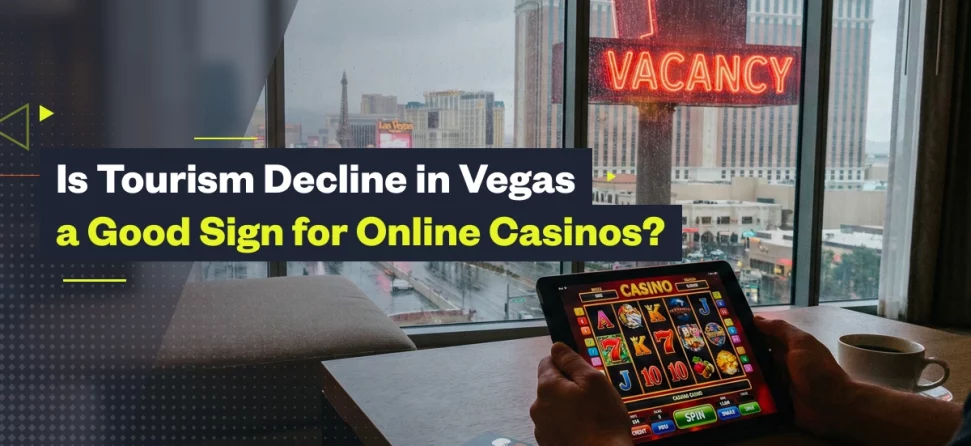
Is Las Vegas tourism decline good for online casinos? It is a reasonable question, and the timing of the numbers makes it tempting to say yes automatically. Vegas tourism cratered in 2025. Online casino revenue grew nearly 30% in the same period. But correlation is not causation, and the full picture is more interesting than the headline suggests.
Here, we look at what is actually happening on both sides of that equation.
Las Vegas Just Had Its Worst Year Since the Pandemic
Las Vegas tourism decline in 2025 was the worst the city has seen outside of COVID. Total visitors fell to 38.5 million, down 7.5% from 41.6 million in 2024, according to the Las Vegas Convention and Visitors Authority, capping 12 straight months of year-over-year declines. That is the sharpest single-year drop since the LVCVA began keeping records in 1970.
The causes are layered. International travel took the most visible hit, with Canadian visitors down 24% following a deterioration in US-Canada relations tied to tariff policy. Mexican and other international markets softened for similar reasons. Domestically, weakened consumer confidence and rising travel costs kept budget-conscious visitors home. Hotel occupancy dropped 3.3 points to 80.3%, average daily room rates fell 5% to $183.52, and revenue per available room was down 8.8%.
The Twist: Vegas Casino Revenue Was Actually Fine
Here is where the story gets more complicated. Despite the steep drop in visitors, Las Vegas Strip gaming revenue finished 2025 at roughly $8.8 billion, essentially flat year over year and a new annual record. Fewer people came, but those who did spent more. Caesars reported a 20% profit drop, reflecting the squeeze from lower occupancy and higher operating costs rather than a collapse in gambling itself.
What that tells you is that Vegas did not lose its high-roller base in 2025. It lost its recreational gamblers. The mid-tier player who drives or flies in, loses a few hundred dollars over a long weekend, eats at a buffet, and heads home. That is the demographic that stayed away. And that is exactly the demographic that online casinos are best positioned to absorb.
Why That Specific Player Is Migrating Online
According to the LVCVA’s 2025 visitor profile, complaints about pricing among Vegas visitors climbed from 14% in 2022 to 22% in 2025, the highest recorded in at least five years. Resort fees now routinely add $40 to $60 per night to the room rate. Parking charges appeared at properties that had previously offered it for free. Comps for mid-tier players have thinned considerably. The recreational gambler who used to offset travel costs with free meals and show tickets now has to run the full numbers before booking, and those numbers increasingly do not add up.
For that player, online casinos remove the overhead entirely. The games are the same. Blackjack, slots, roulette, poker, and live dealer tables are all available from home. There are no flights, no hotel minimums, and no resort fees. The G2E 2025 conference, the gambling industry’s biggest annual event, was held in Las Vegas as the city’s tourism numbers cratered. Its agenda barely acknowledged the decline. It focused almost entirely on online gambling growth. The industry knows where that displaced recreational player is going.
What the Online Casino Numbers Actually Show
US iGaming revenues grew nearly 30% year over year in Q3 2025, generating $2.7 billion across the seven states where online casino gambling is legal, according to the American Gaming Association. For the full year, online casino gaming recorded $10.74 billion in revenue, reflecting 27.6% growth. Every one of the seven iGaming states saw revenue growth.
That is a striking number, but it needs context. Online casino gambling is legal in only 7 states. Much of that growth reflects market maturation in places like New Jersey, Michigan, and Pennsylvania, which have had legal iGaming for several years and are still expanding their player bases.
The Vegas tourism decline is one input into a much larger shift that was already underway before 2025, driven by mobile accessibility, better products, and broader consumer comfort with online gambling. The timing lines up, but the causal link is harder to draw cleanly.
What the data does support more clearly is this: the conditions that are hurting Vegas, rising costs, value erosion for mid-tier players, and a general reassessment of travel spending, are the same conditions that make offshore casinos and regulated online platforms a more attractive alternative. Whether players are consciously choosing online over Vegas or simply making separate decisions driven by the same economic pressures, the outcome is similar.
Where That Leaves Players Considering the Switch
If you are in the recreational gambler category that used to make the Vegas trip and are now doing the math differently, the online options are genuinely solid.
Ignition is the strongest pick for players who want poker alongside casino games. Wild works well for slots-focused players who want a large library without friction. Bovada covers casino, poker, and sports betting under one account. For sports bettors specifically, BetOnline and BetUS are the most established offshore options, with lines comparable to what you would find in a Vegas book.
None of them is a direct substitute for a Vegas trip in the experiential sense. But if the math on the trip stopped working, they would cover the gambling part.
Is It Legal to Play Online Instead?
Individual players in the US are not prohibited under federal law from using offshore gambling sites. The legal exposure around offshore gambling applies to the operators, not the players, and there is no record of a US player facing federal prosecution for using one. State laws vary, so it is worth knowing where your state stands before depositing.
If you gamble, do it within your means. Most reputable offshore sites offer deposit limits and self-exclusion tools if you need them.
Frequently Asked Questions
The LVCVA is cautiously optimistic, citing a strong events calendar that includes ConExpo, WrestleMania, and the Formula One Grand Prix. Convention bookings are trending up. But the structural issues around pricing and international travel remain unresolved, and several major airlines have already cut seat capacity to Las Vegas for early 2026. A partial rebound is likely. A full return to 2024 levels is less certain.
As of 2025, a small number of states have legalized online casino gambling, including New Jersey, Pennsylvania, Michigan, Connecticut, Delaware, and West Virginia. Players outside those states who want to access online casino games typically use offshore operators, which are accessible from most of the country.
Yes, in a few meaningful ways. Licensed US casinos operate under state regulations, which means tighter oversight but also geographic restrictions, narrower game libraries in some cases, and more conservative bonus structures. Offshore casinos operate outside US jurisdiction, which gives them more flexibility on bonuses, crypto banking, and game selection, but without the same regulatory backstop. Both have their tradeoffs.
Visitor numbers dropped sharply, but gaming revenue on the Strip was roughly flat in 2025, finishing near $8.8 billion. The players who did show up spent more. That dynamic points to a bifurcation: high rollers kept coming, recreational players stayed home. It is the recreational segment that online casinos are best positioned to absorb.
The Bottom Line
Las Vegas tourism fell to its lowest point since the pandemic in 2025, but Vegas itself did not lose its gambling revenue. It lost its recreational visitors, who were already being priced out before the broader decline hit. Online casino revenue grew nearly 30% over the same period, driven partly by market maturation and partly by the same economic conditions making Vegas harder to justify. The link between the two trends is real, but it is more structural than it is direct.
If the math on a Vegas trip has stopped working for you, the online options have gotten good enough that it is a reasonable alternative. Not because Vegas is dying. It is because online gambling has gotten genuinely competitive on its own terms.
Where to Play Instead

Deposit Methods:
-
 Visa –
 -
 MasterCard –
 -
 American Express –
 -
American Express

Deposit Methods:
-
Visa –
-
MasterCard –
-
American Express –
-
 Bitcoins



 Contact Taylor